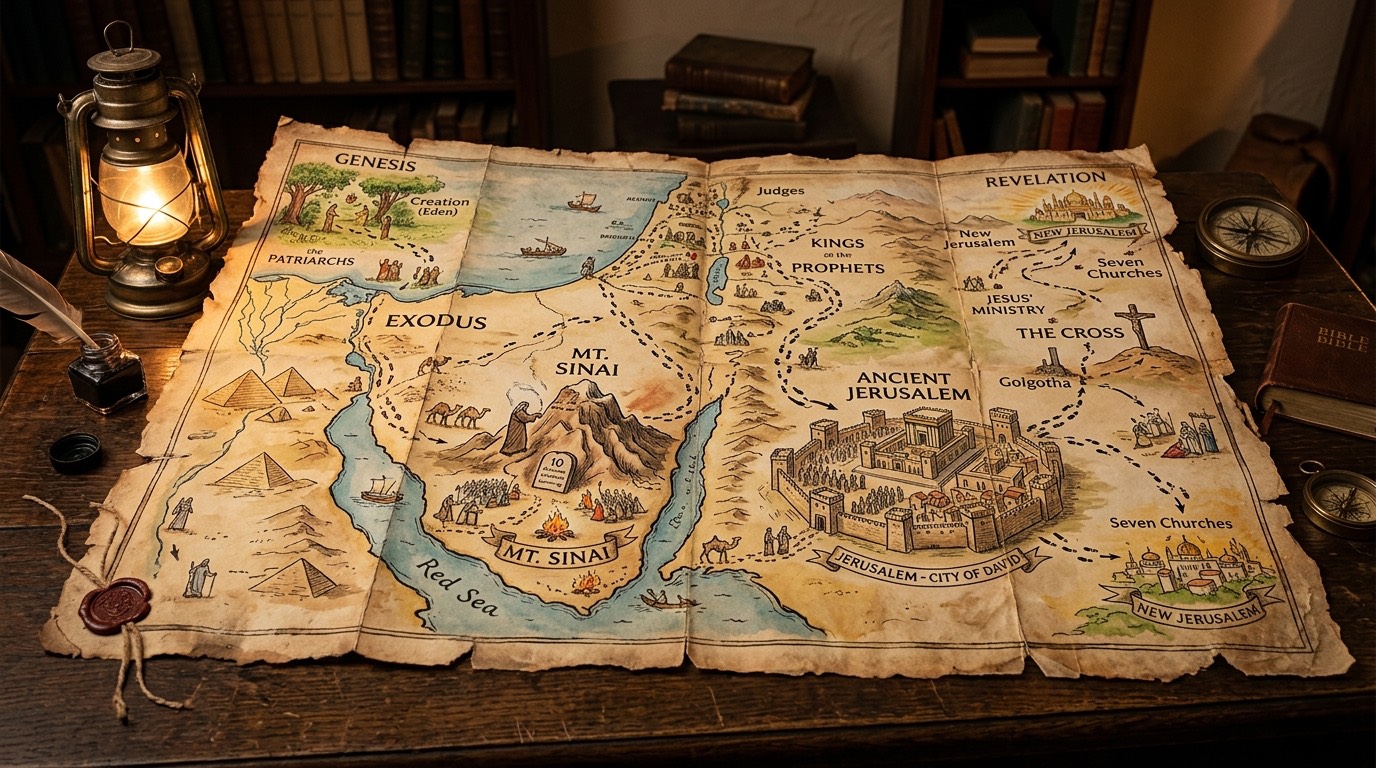
Every January, hundreds of thousands of Christians resolve to read through the Bible in a year. They start with enthusiasm in Genesis, marvel at the parting of the Red Sea in Exodus, and then hit an abrupt, demoralizing roadblock around Leviticus chapter 13.
One of the biggest reasons readers burn out is that most modern Bibles are not arranged in chronological order. Instead, they are organized by literary genre:
- Old Testament: Law (Genesis–Deuteronomy) → History (Joshua–Esther) → Poetry & Wisdom (Job–Song of Solomon) → Major Prophets → Minor Prophets.
- New Testament: Gospels → History (Acts) → Pauline Epistles → General Epistles → Prophecy (Revelation).
Reading straight through means that after David becomes king in 2 Samuel, you don't read the psalms he wrote while fleeing for his life in the Judean wilderness until 200 pages later! Similarly, you read through the tragic fall of Jerusalem in 2 Kings, and only months later encounter the impassioned warnings Jeremiah preached to the very kings of that era.
Reading the Bible chronologically reweaves the historical tapestry, making confusing passages burst into vibrant, cohesive life.
The Major Chronological Realignment Points
To read the Bible in the historical order of events, you must understand three major structural adjustments:
1. The Book of Job Belongs in Genesis
Although Job appears right before Psalms in your table of contents, Job lived during the patriarchal era (around the time of Abraham or even earlier). His lifespan (over 200 years), wealth counted in livestock, and role as family priest offer unmistakable clues. Reading Job alongside Genesis 11–12 contextualizes suffering within the dawn of human history.
2. The Prophets Belong Inside the Books of Kings & Chronicles
The prophets were not detached commentators writing generic poetry; they were divine messengers sent to specific kings of Israel and Judah during moments of military siege and spiritual apostasy:
- Jonah, Amos, and Hosea: Prophesied to the Northern Kingdom of Israel before its fall to Assyria in 722 BC.
- Isaiah and Micah: Ministered in Judah during the reigns of Uzziah, Jotham, Ahaz, and Hezekiah.
- Jeremiah and Habakkuk: Wept over Jerusalem in the final decades before the Babylonian exile.
- Ezekiel and Daniel: Ministered while in captivity in Babylon.
3. Paul’s Epistles Belong Inside the Book of Acts
In the New Testament, reading Paul’s letters chronologically alongside Luke's travelogue in Acts provides breathtaking clarity:
- Read Galatians after Paul’s 1st missionary journey (Acts 13–14).
- Read 1 & 2 Thessalonians during Paul’s stay in Corinth on his 2nd journey (Acts 18).
- Read 1 & 2 Corinthians and Romans during his 3rd journey in Ephesus and Greece (Acts 19–20).
- Read the Prison Epistles (Ephesians, Philippians, Colossians, Philemon) while Paul is under house arrest in Rome (Acts 28).
The 6-Era Chronological Framework for 2026
Here is a clean 6-stage roadmap you can use to journey through the grand story of redemption this year:
Era 1: Foundations & Patriarchs (Creation to ~1800 BC)
Key Books: Genesis 1–11 → Job → Genesis 12–50.
The Narrative Arc: Creation, the Fall, the Flood, Babel, and God’s covenant with Abraham, Isaac, Jacob, and Joseph.
Era 2: Exodus, Wilderness & Conquest (~1446 – 1375 BC)
Key Books: Exodus, Leviticus, Numbers, Deuteronomy, Joshua.
The Narrative Arc: Deliverance from Egypt, the giving of the Law at Mount Sinai, 40 years of wilderness wandering, and entering the Promised Land.
Era 3: Judges & The United Monarchy (~1375 – 931 BC)
Key Books: Judges, Ruth, 1 & 2 Samuel, 1 Kings 1–11, 1 Chronicles, Psalms (interspersed), Proverbs, Ecclesiastes, Song of Solomon.
The Narrative Arc: The cycle of rebellion under the judges, the rise of Samuel, King Saul, David’s reign and worship songs, and Solomon’s golden temple.
Era 4: Divided Kingdom, Prophets & Exile (931 – 538 BC)
Key Books: 1 & 2 Kings, 2 Chronicles, Obadiah, Joel, Jonah, Amos, Hosea, Isaiah, Micah, Nahum, Zephaniah, Habakkuk, Jeremiah, Lamentations, Ezekiel, Daniel.
The Narrative Arc: The split between Israel and Judah, constant idolatry, divine warnings through prophets, the Assyrian and Babylonian conquests, and exile.
Era 5: Return from Exile & The 400 Silent Years (538 – 4 BC)
Key Books: Ezra, Nehemiah, Esther, Haggai, Zechariah, Malachi.
The Narrative Arc: Cyrus permits Jews to return, rebuilding the altar and temple, rebuilding the walls of Jerusalem, and Malachi’s final prophecy before 400 years of silence.
Era 6: The Gospels, Early Church & New Creation (4 BC – 95 AD)
Key Books: Matthew, Mark, Luke, John (read harmonized), Acts (intertwined with the Epistles of Paul, Peter, James, and John), and Revelation.
The Narrative Arc: The incarnation, ministry, death, and resurrection of Jesus; the descent of the Holy Spirit at Pentecost; the explosion of the global church; and the glorious promise of Christ’s return.
Practical Tips to Prevent Burnout
- Don’t Turn Devotion Into a Legalistic Checklist: If you fall 4 days behind, do not try to speed-read 16 chapters in guilt. Simply resume reading today. Grace covers your schedule.
- Use Semantic Search When You Hit Confusing Passages: When encountering strange rituals in Leviticus or apocalyptic beasts in Daniel, pause and use Alpha Bible AI to ask: "What did this animal sacrifice point to regarding Christ?" Understanding the "why" keeps your curiosity alive.
- Listen on Audio While Commuting: On days when your eyes are exhausted, listen to an audio Bible during your morning walk or drive. Faith comes by hearing (Romans 10:17).
Start Your Chronological Journey Today
The Bible is not a disjointed collection of moral fables; it is one grand, unified, drama of redemption authored by the Holy Spirit. Start reading chronologically today, and watch the tapestry of God's redemptive plan unfold before your eyes.